EN
EN


Disunie Double Essence Serum Series: Unlocking the journey of luxurious skin transformation
2025/04/17
2026/08/27
For a skincare distributor, choosing a new brand involves more than comparing products and prices. One of the first questions is often simple: Has this brand already reached real markets?
Sagaci Research provides an independent reference for Disaar.
Using product scan data from its pan-African SagaPoll Shopper Panel, Sagaci Research compared beauty and personal care brands across 46 African countries. In its 2024 ranking, Disaar was found in 32 countries, placing it among the Top 20 brands ranked by country coverage. Sagaci identifies Guangzhou Livepro Beauty Cosmetic Co. as the manufacturer of Disaar. [1]
The Sagaci ranking covers the wider beauty and personal care sector and is based on market presence, not sales revenue or market share. According to Sagaci's methodology, the data came from product scans submitted by panel members and was collected in May 2024. [1]
For skincare distributors considering Disaar for the first time, this does not prove that every product will perform in every country. But it does provide one useful signal: Disaar is not starting from zero in the African market.
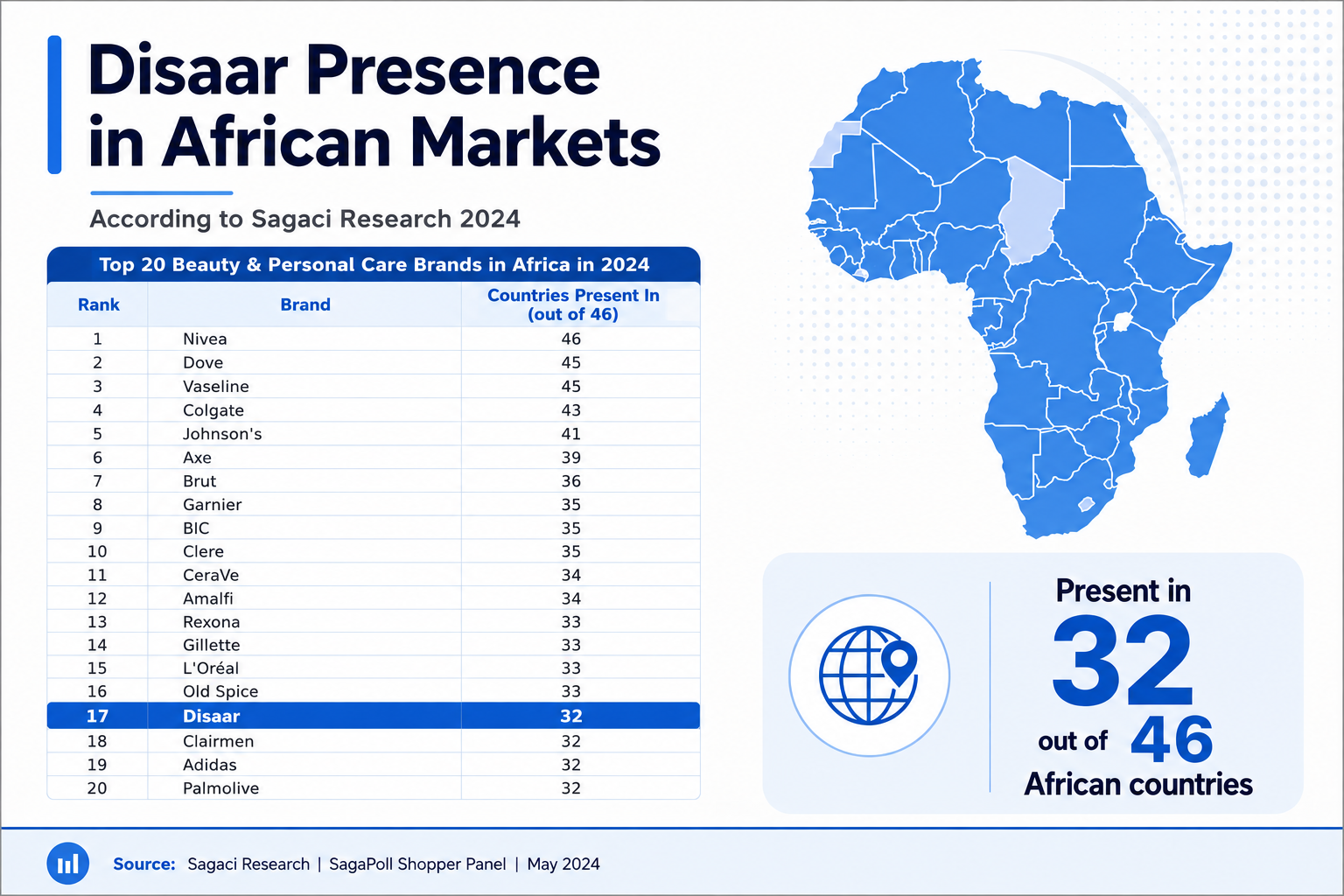
Sagaci's Top 20 ranking includes international brands such as Nivea, Dove, Vaseline, Colgate, Garnier, CeraVe and L'Oréal. Disaar appears in 32 of the 46 countries covered by the Shopper Panel.
This is useful for skincare buyers because market presence is one way to reduce uncertainty when evaluating an unfamiliar brand.[1]
It shows that Disaar products have already reached consumers across different African markets rather than being a brand preparing for its first entry into the region.
At the same time, the Sagaci data should be read carefully.
32-country presence does not mean:
What it does show is that the brand has developed a footprint across a relatively broad part of the region.
This matters because, as Sagaci points out, maintaining cross-country presence in Africa is not simple.
One of the useful points in Sagaci's analysis is that Africa should not be treated as one uniform consumer market.
The continent includes 54 countries, more than 40 currencies, hundreds of languages, and different cultures and consumption habits.
For skincare distributors, this means a product range that works in one country should not automatically be copied into another.
| Market Factor | What It Means for a Distributor |
|---|---|
| Different skincare needs | Select products according to local demand |
| Different price levels | Match products to realistic retail prices |
| Different sales channels | Build the range around existing customers |
| Different competitors | Look for gaps in the current market |
| Different buying habits | Test selected SKUs before expanding |
This is why Disaar's presence in 32 countries should be viewed as evidence of market reach, rather than a reason to use one standard skincare range across Africa.
For a new buyer, the better question is not:
Which Disaar products sell in Africa?
It is:
Which Disaar skincare products fit my market?
Sagaci also highlights the role of distribution.
Using Nivea as an example, the research notes that broad market coverage involves more than modern retail. The brand also works through traditional retail, pharmacies and other outlets. Sagaci describes traditional retail as an important distribution channel for personal care products in Africa.
The same principle is useful when selecting Disaar skincare products.
Different channels may require different product combinations.
| Sales Channel | Possible Disaar Product Direction |
|---|---|
| Wholesalers / Traditional Retail | Daily-use facial and body care |
| Skincare Stores | Serums, creams and ingredient-focused products |
| Supermarkets / Retail Chains | Daily skincare and clear product series |
| Pharmacies | Skincare with clear product positioning |
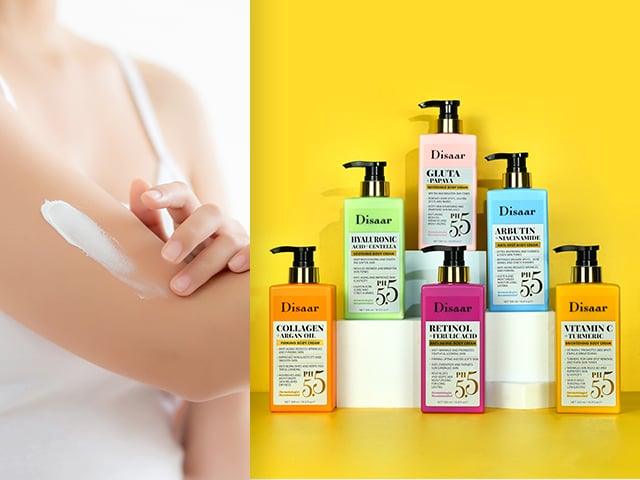
Disaar currently offers a wide range of facial skincare, body care and sun care products. Its catalog includes product formats such as facial cleansers, serums, creams, lotions, masks, soaps, body lotions and sunscreens, with series built around ingredients such as Vitamin C, Hyaluronic Acid, Niacinamide, Collagen, Retinol and Kojic Acid.
For distributors, the benefit of this range is not that more SKUs should be ordered at the beginning.
It provides more options to build a skincare range around the distributor's existing sales network.
A wholesaler may begin with daily-use facial and body care. A skincare retailer may focus more on serums, creams and ingredient-led series. Another market may have stronger demand for moisturizing, brightening or sun care products.
A smaller range can be tested first and expanded according to actual sales.
Sagaci's research also points to stronger competition from African companies.
The article mentions West African companies including Sivop, Nouvelle Parfumerie Gandour, Dream Cosmetics and GDK. Some have expanded beyond their home markets, supported by local market knowledge and regional distribution.
This is an important point for an international skincare brand.
Existing market presence alone is not enough.
For a distributor considering Disaar, three questions are more useful:
This is also why a large catalog should not automatically lead to a large first order.
One market may have more demand for Vitamin C skincare. Another may need basic moisturizing products, body lotions or sun care. Disaar provides different options, but selection should still start from local demand rather than the number of available SKUs.
Sagaci's findings reinforce this point: brands operating across Africa still have to adapt to different local markets and growing local competition.
Sagaci's ranking helps show where brands are present. For a skincare distributor, however, market presence is only part of the decision.
Once a product begins selling, repeat supply becomes more important.
A distributor normally needs to confirm whether the supplier can support:
The production system behind Disaar includes raw-material quality control, production-process monitoring, finished-product testing and traceability. The factory information also shows automated filling and packaging production lines.
These systems matter mainly for one practical reason: a distributor needs to be able to replenish skincare products after they begin selling.
There is little value in successfully introducing a product if repeat orders cannot be supported.
Sagaci's research gives new Disaar buyers two useful signals at the same time.
First, Disaar already has measurable market presence across 32 of the 46 African countries covered by the research. [1]
Second, those countries should not be treated as one uniform market. Consumer needs, channels, prices and competitors can be different.
A new distributor can therefore start with a simple market check:
| Before Selecting Products | Consider |
|---|---|
| Country / Region | Local skincare needs and competition |
| Sales Channel | Wholesale, skincare store, supermarket, pharmacy |
| Target Price | Expected retail price and margin structure |
| Product Direction | Facial care, body care or sun care |
| Starting Range | Selected SKUs rather than the full catalog |
For example, a distributor already supplying facial skincare may not need to introduce every Disaar series at the same time.
It may be more practical to start with several products that fit the current customer base, observe repeat orders and retailer feedback, and then add related products.
This reduces the need to make a large portfolio decision before there is local sales data.
Sagaci Research gives skincare distributors an independent reference when evaluating Disaar.
Its Shopper Panel found Disaar in 32 African countries, within a ranking based on brand market presence across 46 countries. [1]
That number should not be treated as a guarantee that every Disaar skincare product will succeed in every market.
Instead, it shows that Disaar already has a footprint across a significant number of African markets while operating in the fragmented and competitive environment described by Sagaci.
For a new skincare distributor, the next question is therefore less about:
“Is Disaar already present in Africa?”
and more about:
“Which Disaar skincare products fit my country, customers and sales channels?”
A selected skincare range can be used to test the market first, with additional products added according to actual demand.
Data Sources:
[1] Sagaci Research. The Top 20 Beauty and Personal Care Brands in Africa in 2024.
https://sagaciresearch.com/beauty-and-personal-care-brands-in-africa-in-2024/