EN
EN


Disunie Double Essence Serum Series: Unlocking the journey of luxurious skin transformation
2025/04/17
2026/03/31
Choosing between ready stock and OEM is not only a sourcing question. It is a timing, a risk, and a growth question.
This article compares ready stock and OEM hair color shampoo for speed, customization, risk, and growth. Trying to build a practical guide for buyers, importers, and brand owners to choose the right supply model.
If you are still reviewing the broader hair color shampoo supply options, it helps to start with the full category picture before deciding on a supply model.
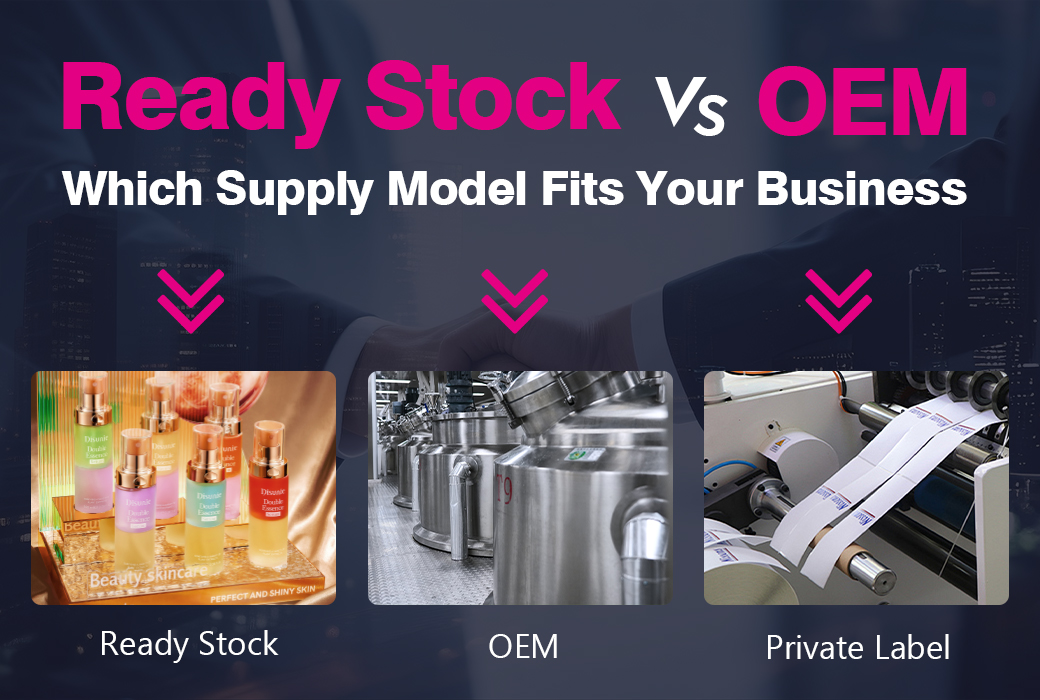
Ready stock means you are working with an existing, already-developed product. The formula is set, production is ready, and shipment can happen quickly. In Livepro, we typically take 1–3 days for branded stock products.
This model works well for:
OEM (Original Equipment Manufacturing) means you ask the factory to build a customized project around your specific formula, shade targets, packaging, and positioning. This gives you more control, but adds steps: samples, revisions, packaging confirmation, and production planning. It typically takes 25–35 days or more.
Private Label sits in the middle. You get a commercially proven base product with your own branding. It's faster than full OEM.
(1) You need to enter the market quickly.
South American retail channels, from Santiago to Bogotá to Lima, move fast. A distributor may need a dark-shade item within weeks, not months. Ready stock delivers that speed.
(2) You are testing demand.
For first-time brand buyers, ready stock is the lowest-risk way to learn:
(3) Your selling story is already simple.
Hair color shampoo often works best when the message is direct: black or dark brown shades, easy home use, and visible gray coverage. If that is already the selling logic, ready stock can be enough to start.
(4) You want to reduce internal coordination
Fewer sample rounds. Fewer packaging delays. Less waiting for approvals. For many importers, this shorter path to launch is not just about time. It is about keeping the project manageable.
Here's what actually worked for many early-stage buyers: start with a tight stock offer, learn which shades and messages are getting traction, then decide whether deeper customization is worth the extra cycle.
(1) You need stronger differentiation.
If your line needs a more specific formula story, a clearer care-plus-color position, a particular scent direction, or a tighter match between packaging and brand image, OEM gives you more room to build that identity.
(2) You already know what your market wants.
If you already know the winning shade range, the strongest claim direction, and the channel that will carry the product, then extra development time can be worth it.
(3) You are building long-term brand ownership, not just short-term product availability.
A customized project can support more control over how the line looks, how it is positioned, and how easily it can be copied.
Many buyers frame the choice as stock or OEM, but that skips the most practical middle option.
Private label hair color shampoo gives you:
That is especially useful for:
A realistic progression for many buyers:
Ready stock fits best, especially when the category is being added for practical demand rather than deep brand storytelling.
Private label is often the best. It allowed a branded launch without stretching the timeline too much.
You are more likely to benefit from OEM. You already have a clear market position, internal decision-making, and visibility into what formula or packaging differences are worth building.
If you are entering hair color shampoo for the first time, especially in markets like Chile, Peru, or Colombia. A fast stock launch teaches you more than a long custom project. Test channel response first, then scale.
| Factor | Ready Stock | Private Label | OEM |
| Time to launch | 1–3 days | 15–25 days | 25–35+ days |
| MOQ flexibility | 1 carton | 3000-5000pcs | 5000pcs |
| Packaging control | Limited | Strong | Full |
| Formula control | None |
Stock formula | Full |
| Brand ownership | Low | High | Highest |
| Inventory risk | Low | Medium | Higher upfront |
(1) choosing OEM before proving demand.
A full custom project is expensive to test too early.
(2)choosing stock when the brand clearly needs stronger differentiation.
If your packaging looks generic, it is harder to stand out on crowded shelves.
(3)starting with too many SKUs.
Keeping your first lineup tight reduces unnecessary risk, especially when demand is uncertain.
(4)Focusing only on unit cost.
A cheaper first order is not always better if the product is harder to explain, easier to replace, or slower to scale.
(5)Underestimating packaging impact.
Packaging changes can quietly turn a fast project into a slow one.
The move usually makes sense when:
That is the turning point.
Ready stock helps you learn.
OEM helps you own more of what you have learned.
Ready stock is not the weak option.
OEM is not automatically the smart option.
Private label is often the most practical path between them.
The best supply model depends on where your business is right now — and where you want to be in the next 12 months.
If you need speed, lower complexity, and a fast test of practical demand → Ready stock
If you need stronger brand ownership without a full development burden → Private label
If you already know what your market wants and you are ready to build a more defensible line → OEM
Need Help Choosing?
If you are still deciding between ready stock, private label, and OEM, the next useful step is to compare your launch timing, target channel, and first SKU plan before committing.