EN
EN



Disunie Double Essence Serum Series: Unlocking the journey of luxurious skin transformation
2025/04/17
2026/08/15
Turmeric has moved far beyond its traditional use in home beauty routines. Today, it appears in facial cleansers, serums, creams, body lotions, scrubs, oils, and exfoliating products.
One reason is simple: consumers are paying more attention to dark spots, dull-looking skin, post-blemish marks, and uneven skin tone.
At the same time, many shoppers want brightening products that are familiar and easy to understand. Turmeric fits this space well because it combines a recognizable botanical identity with a clear brightening skincare position.
Compared with other popular brightening ingredients, turmeric also has its own role. Our comparison of Turmeric vs Kojic Acid vs Vitamin C looks more closely at how these ingredients differ in daily radiance, dark-spot care, and botanical brightening.
Turmeric's biggest advantage is its flexibility. It can work across both facial and body care, making it relevant to a wider range of skin concerns and product formats.
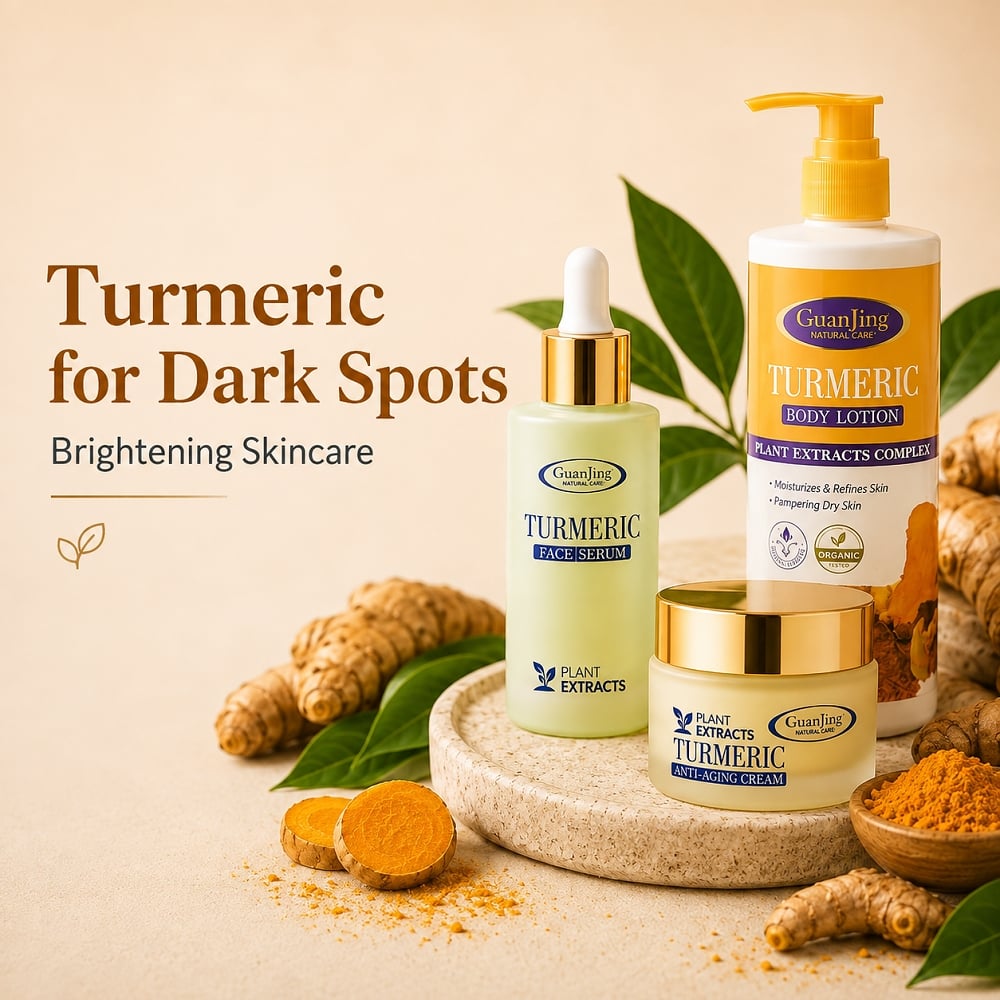
Brightening is often used as a broad skincare term, but consumers may actually be looking for different results.
Common concerns include:
For people concerned about marks left after breakouts, a broader post-acne marks skincare routine may also involve hydration, soothing care, and sun protection.
Brightening today is therefore less about one broad promise and more about improving the appearance of tone, clarity, radiance, and visible marks.
This distinction also explains why different ingredients can have different positions.
Vitamin C is commonly associated with glow and daily radiance. Kojic acid is more strongly linked with targeted dark-spot and uneven-tone care. Turmeric sits somewhere different: it combines brightening with a more botanical and everyday skincare image.
That makes it flexible enough to work in both regular skincare and more targeted tone-care routines.
Turmeric works well in brightening skincare for several reasons.
Turmeric is already familiar in many markets as a plant ingredient used in food, wellness, and traditional beauty care.
Consumers often recognize the ingredient name without needing a long technical explanation.
This creates a simple product message:
botanical ingredient + brightening care + more even-looking skin
For products targeting consumers who prefer recognizable plant-based ingredients, this can be easier to communicate than a highly technical active ingredient.
Some brightening ingredients are closely connected with targeted treatment products.
Turmeric can support a broader daily-care position.
It can appear in:
This allows turmeric to work in both everyday skincare and more focused brightening routines.
This may be turmeric's most useful advantage.
Many brightening ingredients are best known through facial serums or creams. Turmeric can move naturally into body care without making the product concept feel forced.
That matters because uneven-looking tone is not only a facial skincare concern.
Brightening skincare has traditionally focused heavily on the face, but uneven-looking tone can also be a body-care concern.
Consumers may pay attention to areas such as:
This is one reason brightening ingredients are appearing in more body-care products.
A consumer may choose a facial serum for visible post-blemish marks while using a lotion or oil for larger body areas.
The underlying concern may be similar, but the product format needs to change.
Body products usually need to spread easily, absorb comfortably, and work across larger areas. This creates more room for lotions, washes, scrubs, oils, and exfoliating products.
Turmeric fits these formats well because its ingredient story is broad enough to move across different steps in a routine.
Turmeric is often discussed as a facial skincare ingredient, but its body-care potential may be even more interesting.
A turmeric body wash can introduce the brightening concept at the cleansing stage.
The product may focus on:
Because body wash is used frequently, it also gives the turmeric concept regular visibility in a consumer's routine.
Scrubs are naturally connected with:
Adding turmeric gives the product another brightening and botanical angle.
The combination works particularly well when the product is positioned around texture and tone, rather than brightening alone.
Peeling oils, gels, and similar exfoliating products usually have a more targeted position than daily body wash or lotion.
Turmeric can help connect exfoliation with a broader brightening story.
The role here is different from a daily moisturizer: the product is used less frequently and is more closely linked with visible texture and dead-skin buildup.
For more on this category, see our guide to peeling oil products.
Body lotion may be one of the strongest formats for turmeric.
It fits daily use, covers large skin areas, and can combine several benefits:
Unlike an exfoliating product, lotion also supports regular maintenance.
This makes turmeric body lotion suitable for consumers who want brightening body care without making every step intensive.
Body oil brings another angle.
Instead of focusing mainly on exfoliation or lightweight hydration, it can emphasize:
The product story becomes nourishment + glow + body-care ritual.
Turmeric therefore works across several very different body-care experiences rather than being limited to one type of product.
Body care may give turmeric more room to expand, but facial skincare remains important.
Common turmeric facial products include:
A cleanser is one of the simplest entry points.
It introduces turmeric through a daily-use product without requiring consumers to add a separate treatment step.
Serums give turmeric a more targeted skincare position.
They are better suited to consumers already concerned about dullness, visible marks, or uneven-looking tone.
Turmeric creams can combine brightening with moisturizing.
This works well for consumers who prefer fewer steps and want one product to support both moisture and tone care.
Masks offer more flexibility for botanical ingredient stories and occasional-use skincare.
Turmeric fits naturally into brightening and self-care concepts.
The important point is that turmeric does not depend on one hero product format. It can appear across cleansing, treatment, and moisturizing without losing its core ingredient identity.
Turmeric does not always need to work alone.
Brightening products often combine ingredients because uneven-looking tone is rarely the only consumer concern.
A product may also need to support:
This leads to several useful ingredient directions.
This combination connects a botanical ingredient story with a familiar radiance ingredient.
Turmeric brings the plant-based identity, while vitamin C strengthens the daily brightening and glow message.
Niacinamide is often used in products positioned around tone, oil balance, and barrier support.
Combined with turmeric, it can create a broader daily-care concept rather than focusing only on brightening.
This direction is particularly relevant in body oils, lotions, and richer creams.
The positioning becomes less about targeted dark spots and more about:
nourishment + glow + even-looking skin
Exfoliation can help improve the appearance of rough and dull-looking skin.
In body-care products, turmeric can support the brightening story while exfoliating ingredients focus more directly on texture and buildup.
For consumers or buyers comparing stronger targeted brightening concepts, kojic acid skincare products provide a different position centered more clearly on visible dark marks and uneven tone.
The key point is that the most suitable ingredient combination depends on the role of the product.
A body scrub does not need the same ingredient strategy as a facial serum, and a daily lotion should not be positioned like an intensive exfoliating treatment.
Turmeric is not the newest brightening ingredient on the market.
That may actually be part of its strength.
Its continued relevance comes from four qualities.
Many consumers already know turmeric.
That reduces the amount of education required.
Turmeric gives products a plant-based identity that differs from more clinical brightening concepts.
It can appear in:
Turmeric can support product messages around:
This flexibility is especially useful when consumers want familiar ingredients but still expect products to address more specific skincare concerns.
The most important shift in turmeric skincare is not simply that more facial serums contain turmeric.
It is that the ingredient is moving across the whole skincare routine.
For facial care:
Cleanser → Serum → Cream
For body care:
Body Wash → Scrub → Lotion → Body Oil
This gives turmeric a wider role than ingredients that are strongly tied to one product type.
A facial serum can focus on radiance and uneven-looking tone.
A body scrub can focus on texture and dullness.
A body lotion can focus on daily moisture and tone care.
A body oil can focus on nourishment and glow.
The ingredient remains recognizable, but the consumer need changes with the product.
This is what gives turmeric more room to develop across a full brightening category.
Turmeric keeps appearing in brightening skincare because it connects several strong ideas at once:
botanical skincare, more even-looking tone, face care, and body care.
It does not need to replace vitamin C or kojic acid.
Vitamin C remains highly recognizable for daily radiance. Kojic acid has a clearer position around visible dark spots and targeted uneven-tone care. Turmeric stands out by offering a more botanical route into brightening while working across a wide range of product formats.
Its strongest opportunity may be in body care, where consumers are increasingly looking for products that do more than basic cleansing or moisturizing.
As body washes, scrubs, lotions, oils, and exfoliating products become more targeted, turmeric has room to stay relevant without depending on short-term ingredient hype.
For brightening skincare, that flexibility may be more important than being the newest ingredient on the label.
Different brightening ingredients create different product opportunities. Businesses comparing ready-stock options can explore turmeric alongside kojic acid, vitamin C, niacinamide, arbutin, and other brightening concepts across facial and body care.