EN
EN



Disunie Double Essence Serum Series: Unlocking the journey of luxurious skin transformation
2025/04/17
2026/08/18
Body oils have long been part of body-care routines, mainly for moisturizing and nourishing the skin. However, as consumers look for products that are easier to use every day, lighter textures have become more important.
This is where dry oil stands out.
Unlike richer body oils, dry oil is designed to provide an oil-based skin-care experience with a lighter texture and faster absorption. It can also be developed around different ingredients, making it suitable for a range of body-care concepts.
For wholesalers, distributors, and product buyers, this flexibility makes Dry Oil an interesting category to watch. A single product format can support different ingredient stories, price segments, and consumer needs.
Dry oil is an oil-based skincare product designed to moisturize and nourish the skin while providing a lightweight finish.
The term “dry” does not mean that the product contains no oil. It mainly describes how the formula feels after application. Compared with richer body oils, dry oil is generally designed to spread easily, absorb faster, and leave less of an oily feeling.
Its final texture depends on the combination of oils, emollients, and other ingredients used in the formula.
Common characteristics include:
This makes dry oil suitable for daily body care, particularly after showering or when consumers want a body-care product that does not feel heavy.
From a product-development perspective, the format is also flexible. It can be built around moisturizing, brightening, smoothing, or botanical concepts without changing the basic product category.
Dry Oil vs. Traditional Body Oil: What's the Difference?
Both dry oil and traditional body oil use oils or oil-soluble ingredients, but their textures and finishes can be different.
| Feature | Dry Oil | Traditional Body Oil |
|---|---|---|
| Texture | Lightweight | Often richer |
| Absorption | Faster | May take longer |
| Skin Feel | Less greasy | More oily |
| Daily Use | Easy to incorporate | Depends on the formula |
| Warm & Humid Climates | Often more comfortable | May feel heavy |
| Product Positioning | Moisturizing + targeted care | Mainly nourishment |
The difference is mainly related to formulation and sensory performance, rather than simply the amount of oil in the product.
For markets where consumers prefer lightweight skincare, this difference can be particularly relevant. In warmer climates, for example, a fast-absorbing body oil may be easier to incorporate into daily routines than a heavier formula.
Why Is Dry Oil Gaining Attention in Body Care?
The growth of lightweight skincare formats is not limited to facial products. The same preference is appearing in body care.
Consumers still want the nourishment associated with body oils, but many prefer a lighter finish for everyday use.
Dry oil offers a way to combine these two preferences.
A fast-absorbing texture makes the product easier to use after showering or before getting dressed.
This can also make Dry Oil suitable for consumers who want simple body-care routines with fewer steps.
Traditional body oils can sometimes leave a noticeable oily layer. A lighter formula can appeal to consumers who prefer a cleaner skin feel.
Dry Oil is not limited to basic moisturization.
Depending on the ingredients, it can be positioned around:
This gives distributors and retailers more options when building or expanding a body-care category.
What Ingredients Are Commonly Used in Dry Oil?
Ingredient trends in facial skincare often influence body care as well. Familiar ingredients can give a Dry Oil a clearer product story and make it easier for consumers to understand its positioning.
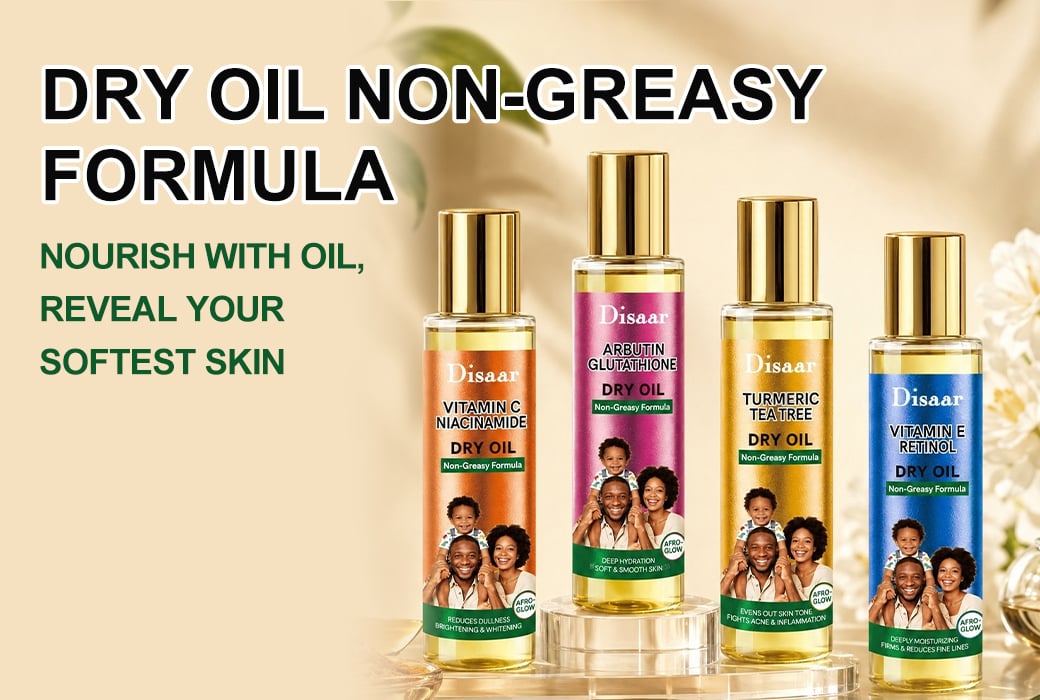
Vitamin C and niacinamide are commonly associated with brightening and radiance-focused skincare.
In body care, they can be used for products positioned around dull-looking skin and a brighter appearance.
Arbutin and glutathione are also used in brightening-focused formulations.
They can support products positioned around more even-looking skin tone, giving the category another direction beyond traditional moisturizing body oils.
Vitamin E is widely used in nourishing skincare, while retinol is associated with skin-renewal and smoothing care.
Together, they can support Dry Oil concepts focused on nourishment, smoother-looking skin, and mature-looking skin.
Botanical ingredients create another product direction.
Turmeric and tea tree can be used in formulas positioned around botanical body care and targeted skin care, particularly for rough-looking skin.
Apply for Disaar Brand Distribution
How Can Different Dry Oil Formulas Meet Different Market Needs?
There is no single Dry Oil formula that fits every market. The preferred ingredients often depend on the main consumer concern and the way the product is positioned.
| Market Need | Ingredient Direction | Possible Positioning |
|---|---|---|
| Dry skin | Nourishing oils, emollients | Moisturizing body care |
| Dull-looking skin | Vitamin C, Niacinamide | Brightening body care |
| Uneven-looking skin | Arbutin, Glutathione | Even-looking skin |
| Mature-looking skin | Vitamin E, Retinol | Smoothing / firming-looking care |
| Rough or targeted body care | Turmeric, Tea Tree | Botanical body care |
For wholesalers and distributors, this type of product segmentation can be useful when evaluating which Dry Oil concepts fit their existing customer base.
A distributor focused on ingredient-led skincare may prefer an active-focused formula, while a mass-market retailer may place more emphasis on simple benefits, familiar ingredients, and accessible pricing.
What Makes a Dry Oil Suitable for Different Markets?
Beyond ingredients, several practical factors can influence how a Dry Oil performs in different markets.
Climate is one consideration when selecting texture.
In hot and humid markets, lightweight texture, fast absorption, and a less greasy finish may be more appealing.
In dry and cold markets, consumers may place greater importance on moisturization and nourishing oils.
Different markets can also show different levels of interest in:
Understanding these preferences can help distributors build a more relevant product range.
The same Dry Oil format can be positioned differently depending on the retail channel.
A mass-market product may focus on straightforward benefits and familiar ingredients, while a premium product may emphasize targeted ingredients, packaging, and a more specialized skin-care concept.
This makes Dry Oil a relatively flexible category for both established body-care ranges and new product lines.
What Should Be Considered When Sourcing Dry Oil?
For wholesalers, distributors, and purchasing teams, product selection usually goes beyond the ingredient list.
Formula and texture are important because the product needs to match the expected skin feel and market positioning.
Packaging also affects the final product concept. Bottle size, pump or spray format, labels, and cartons can all be adapted to different retail channels.
Product specifications and documentation are another practical consideration, particularly for products entering different markets.
And when a product line requires several variations, MOQ, production capacity, lead time, and customization options can influence the overall sourcing decision.
These factors are often more important than simply finding the lowest unit price. A product that fits the market and can be supplied consistently is more likely to support long-term sales.
Dry Oil as Part of a Broader Body-Care Range
One reason Dry Oil is interesting from a product-planning perspective is that it can sit between traditional body care and ingredient-led skincare.
A product range can include different concepts such as:
The format stays consistent, while the ingredient story changes.
For distributors, this type of structure can make it easier to test different consumer preferences or create a broader body-care assortment without introducing completely unrelated product formats.
For brands developing their own range, Dry Oil can also be adapted through formula, fragrance, packaging, and product positioning.
More information about customized skin-oil product development is available on the Private Label Skin Oil Manufacturer page.
Conclusion
Dry Oil combines the nourishing properties of an oil-based format with a lightweight and fast-absorbing skin feel.
Its flexibility is one of its main advantages. Different ingredients can support different product concepts, from moisturizing and brightening to smoothing and botanical body care.
For wholesalers, distributors, and purchasing teams, the most suitable product depends on the target consumer, climate, ingredient preferences, retail positioning, and supply requirements.
As consumer interest in lightweight body care continues to grow, Dry Oil offers a practical format for developing different products within the same category.